|
|
|
|
A Cup of Coffee and Pie Ala ModeA personal account of discovering Grandpa Jake’s life experiencesAccepting the challenge The February e-mail message from Bruce Brolsma was short and to the point. After an innocuous and brief greeting and the customary commentary on Minnesota weather, he quickly described his real reason for sending me his note. "No one has yet to write a story for the web site about the Brolsma’s who settled in the Sherburn area," he stated in the rather profound hope that sympathy would put me up to the task. "Would you be interested in putting together an article on your grandfather and the other Brolsma’s who immigrated to southern Minnesota in the early 1900’s?" he asked, obviously preying upon my deep admiration and love for the man affectionately called Grandpa Jake. "We could even include some digital photos and maybe even some streaming video of past family reunions," he stated in a good-faith attempt to make me believe a lot of pictures would reduce the need for words. As the first drips of perspiration gathered on my ample brow, I desperately sought an appropriate reason for excusing myself from this considerable task. Maybe it was the suddenness of the note. Maybe it was the fact that I was in between jobs and really didn’t have anything else going for the next two months. Maybe it was my naïveté in thinking this would be a piece of cake. After all, seven of Jake’s children were still living close by; each of which I was certain possessed numerous stories about their father and his family. Whatever the reason, I confidently responded, "Sure, I can do the story – just give me a couple of months to put it together. I’ll have it ready by the first of April." Thinking back, it’s probably a good thing I didn’t commit to a specific year. The enormity of the project began to emerge when numerous phone calls to uncles, aunts and cousins revealed that none of us really did know much about Grandpa Jake’s early years. Those were the years that saw him abandon the reliable comforts of family, friends and a rather routine lifestyle in St. Jacobi Parochi, Netherlands and come to America with its promise of economic and social mobility. For it was in America, wrote previous emigrants from Friesland, "we eat meat three times a day and we tip our hats to no one!" The more I thought about why this young man, only eighteen years old, would leave his homeland with only $20 in his pocket (approximately $400 in today’s dollars) and the heartfelt promise of his Uncle Hessel to keep him from harm’s way, the more captivated I became of the intriguing thoughts, fears and challenges Grandpa Jake faced in early March of 1911, as he looked down upon the Rotterdam port from the ship so aptly named "Nieuw Amsterdam."
Like most Frisians coming to America during the turn of the century, Grandpa Jake emigrated from the municipality of his birth, Het Bildt. In all likelihood, his previous travels had been limited to excursions of no more than a few miles from home, even though a young man could easily walk the width of Friesland in thirteen hours and its length in just over fourteen hours. For the first time, he was not only leaving the village he called home, but also his home province and his native country. A March departure was actually a month earlier than the time when most Frisians emigrated to the U.S. Most waited for better spring weather during the months of April and May to make the ocean passage cross the Atlantic. They also believed it was better to arrive in early summer because they still had time to acclimate and search for jobs before the severe winter set in. According to Annemieke Galema in her book, Frisians to America, 1880-1914, the spring departure may also been related to the fact that a farm worker’s seasonal contract usually lasted until May 12 of each year.
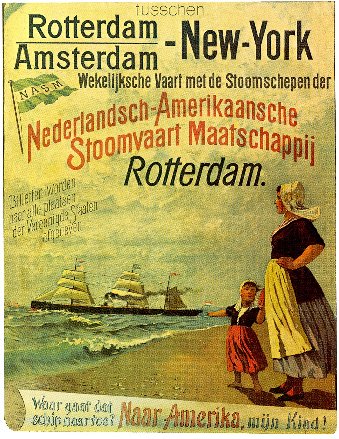
Holland-America Line poster. As the ship set sail from the Rotterdam harbor, the horrific reality of what Grandpa was about to do must have hit him like a brick hurled against the side of his head. A brick, I might add, that didn’t have to be thrown any great distance for Grandpa Jake stood barely five feet tall. For he knew that within two weeks he would be entering New York City, a town containing no family, no friends and speaking a language so foreign that even with sufficient funds, ordering a meal would be no small task. This fact actually formed the basis of the only story I can remember Grandpa telling about his first days in America. It was told by Grandpa sitting around the kitchen table with my cousins and me after one of our many family dinners. Grandpa Jake explained that while he was an educated man by the standards of his day, he could not speak or understand any part of the English language. He would go on to tell us that the only words he could speak in English upon his arrival in the U.S. were "a cup of coffee and pie ala mode!" Unfortunately, this situation didn’t lend itself to a well balanced diet, but it did create a craving for the sweeter things on the table that was handed to each succeeding generation. A perverse restlessness with the social and economic environmentSo what did spur Grandpa Jake and thousands of other Frisians to succumb to the promises offered by America? Each time I asked this very question of family members, I heard the same consistent response, "Well, it was the OPPORTUNITY." It was like they were all saying, "Jeez Brad, don’t be so stupid, Jake recognized the opportunities and possibilities that could only be offered by a new frontier." But time and again, after each interview I kept asking myself what was the opportunity and why was it so attractive to Grandpa? To my dismay, no family member could provide any satisfactory answers to this question or any specific details of Grandpa Jake’s last years in Friesland. I needed help badly and I needed it quick. I turned to the one person who could at least point me in the right direction. Jolke Brolsma had published a history of the Brolsma family in the mid-1990’s after a tremendous amount of time-consuming research and investigative work. No one knew more about the Brolsma families and their late nineteenth century plights than Jolke. If anyone could provide me with some valuable insights, Jolke was to be the man. For once my intuition served me well. Jolke returned my email the very next day and suggested I read Annemieke Galema’s book, Frisians to America, 1880-1914, published and distributed by Wayne State University Press in Detroit. After unsuccessful attempts to purchase the book through the typical Internet channels, I learned the book was now out of circulation and unavailable for purchase. My luck seemed to make a turn for the better when I located a copy at a library on the campus of the University of Minnesota. Unfortunately, it made a quick u-turn when I learned I could only have the book for two weeks. "Come on," I complained to the rather chubby librarian, "I haven’t read a book in less than a month since college." When asked which college I attended, I proudly proclaimed, "Mankato State!" My new-found college pride was quickly dashed when she looked up through those tiny wire-rimmed glasses that all librarians use to look intellectual and said, "Sir, I could allow you a six month sign-out, but you still wouldn’t get halfway through the book." For some reason, I didn’t think she was being very respectful, but I was comforted by the fact that she at least addressed me as "sir." As I exited the building, I was determined to prove this B-school dropout turned librarian dead wrong. Being good at math, I figured if I read ten pages each day I could finish the book by the due date. Of course, my plight was helped immensely by the simple fact I was unemployed and pictures dominated the book. Galema’s book turned out to be a Godsend. Possessing no specific confirmation of what had transpired during Grandpa’s last years in the Netherlands, I was grateful the book provided ample evidence of the frustrations shared by many Frisians regarding economic conditions near the turn of the century. I then took a well-reasoned leap of faith that Grandpa’s disappointments, setbacks and unhappiness were quite similar to those described within the book. Friesland was a strongly agrarian-oriented rural population, particularly in the northern sea clay areas, but as the new century approached, grassland and cattle farms took over at the expense of grain production. Acres devoted to potato production grew at the expense of wheat, oats, barley and flax. In fact, in 1850 over 26,000 hectares were devoted to ag production. By 1914, only half of this land was still being used for similar purposes. This reduced ag production was accompanied by a very severe agrarian depression that began in 1878 and continued into the early years of the next century. While the economic well being of farmers (the landowners) was negatively impacted, the depressed economic conditions affected the land laborers the worst. Even though the first decade of the twentieth century saw significant improvements in ag economic conditions, farm laborers continued to face miserable conditions. With little hope of economic improvement or social mobility, it isn’t surprising they were the highest percentage of Friesland emigrants. From 1880 to 1914, over 10,000 northern Frisians left for America alone. This concentration of farm laborers among emigrants was evidenced in the immigration records from Ellis Island. An examination of the manifest of the ship Grandpa Jake used to reach New York City revealed that over half of the Dutch citizens entering the country (including Grandpa) listed "farmhand" as their occupation. For many Frisians, nutrition was insufficient and unbalanced. Breakfast usually consisted of rye bread with grease or syrup while evening meals were often potatoes with mustard sauce. My Uncle Bob relayed to me a story Grandpa Jake had told him as a young child. While visiting at a friend’s house, Jake was invited to stay for dinner; a meal whose only serving was some kind of potato dish. Famished, Jake’s friend spit into Grandpa’s bowl in a despicable effort to secure additional nourishment. As the story was told by Grandpa, this ingenious strategy failed when Jake, starving for food as much as his buddy, ignored his friend’s misdeed and quickly consumed the "tainted" food. The depressed economic conditions were not helped by the lack of Friesland’s participation in the industrial revolution that was sweeping across Europe in the late 1800’s. As Galema pointed out, "the industrial breakthrough in Friesland began and ended with the dairy business." Many former land laborers were forced to find work in the mines and factories of Germany. In response to this severely depressed state of economic affairs, a farm workers labor union called the Broedertrouw (Brother Loyalty or Brother Faith) was formed in 1888. Just two years later, the newly organized union called its first strike, a strike later judged to be unsuccessful. Union members typically gathered outside local barbershops on the weekends. Since most members came to town on Saturday to get their weekly shave, the barbershop was the perfect setting for voicing discontent and anger with economic conditions and specific landowners. Grandpa Jake’s father, Jacob Sr., ran a barbershop at the Oude Beldtdijk, and was the subject of an article in Jolke’s Brolsma Newsletter in March of 1998. Jolke wrote that Broedertrouw members met regularly at Jacob’s barbershop and for that reason, the farmers (the landowners) no longer wanted to patronize his annex bar. Jacob’s support for the union came at a significant personal cost since the farmers previously represented his best customers. In the article, Jolke went on to tell the story of how late in 1890, Hessel Brolsma, Jacob’s brother and then an unemployed teacher, was sentenced to three weeks in prison for threatening a strikebreaker. The sentence was reduced to eight days in response to a plea from Pieter Jelles Troelstra, a well-known socialist leader and a future member of the parliament. Jolke further explained that it had not been Hessel who had committed the crime, but rather his brother Jacob. With virtually no chance to resume his teaching career in Het Bildt, Hessel immigrated to the United States the next year, and began work as a butcher in Sherburn, Minnesota. Twenty years later, he would sponsor the immigration of his nephew, Grandpa Jake, and in 1912, another nephew, Herman, Grandpa’s younger brother. So what do we now know about Grandpa Jake’s early years and what issues and events drove him to leave home and take his chances in America? Like other potential emigrants, Grandpa Jake most likely relied upon personal information from family who already had made the move to America. In Grandpa’s case, it was probably letters from his Uncle Hessel. For many Frisian laborers, emigration to America was the ultimate answer to their desire to achieve social status and earn an adequate wage. They chose to move to the United States, not because they yearned for adventure, but because they strongly believed that America offered them a better opportunity for economic and social mobility (score one for my relatives – they were right all along). Young Frisians also hungered for independence from the landlord. They had become all too accustomed to a life where authority was concentrated in those individuals and families that owned the land, and where the status of citizens was closely connected to the possession of land. Recognizing that any economic changes were not on the immediate horizon, restlessness among young Frisian males forced many to boldly look to America for hope. During the decade of the 1880’s, only 9% of Frisian emigrants were single males; a surprising fact considering the province was experiencing significant economic problems and labor unrest. Contrast that with the period 1910-1914, when nearly one out of every four emigrants was a single male. Among those numbers were Grandpa Jake and later, his younger brother Herman. In 1900, approximately ten years before Grandpa hit the streets of Sherburn, more than 44% of those people who had immigrated to Minnesota from Holland had become independent farmers, while another 25% worked as farm laborers. But farming operations were different in the U.S. While many farms in Friesland employed seasonal hired hands, in the United States most farm labor came from close family members. As Galema pointed out in her book, "The settlement patterns of the Minnesota Frisians were characterized by the search for farms and farm lands. All efforts were dedicated to the opening of farms on the frontier. These ventures were risky because most of the immigrants were short of cash and very dependent on favorable weather. Good crop years alternated with bad ones. A positive spirit and belief in the future often was crushed by grasshoppers, storms, or droughts, forcing some immigrants to sell everything and leave the community to search for better opportunities. Yet most decided to stay in the hope of a good crop the next year." The April 6, 1911 issue of the Sherburn Advance Standard told of the arrival of Grandpa Jake from Holland. In the paper’s "News of the Town" section, it announced, "Jacob Brolsma of Holland, brother of our genial friend, Hessel, arrived in Sherburn last Wednesday evening and has accepted employment for the summer with Killian Weidenbach." While the editor had erred by not correctly identifying Jake as Hessel’s nephew, Grandpa had reached Sherburn on March 29, just two days after arriving in the New York City harbor. Like his trip across the Atlantic, an eighteen-year old Grandpa Jake had spent two full days in a railroad car without relatives and just a handful of acquaintances. But unlike the boat, he also had to endure listening to passenger conversations carried on in a language with which he had no familiarity. During the first several years of his American residency, a combination of loneliness, homesickness, language frustrations and a bad case of grasshoppers and hog cholera pushed Grandpa dangerously close to giving up and returning home. Once again, counsel from his Uncle Hessel most likely proved to be the deciding factor leading to Jake staying put and anxiously awaiting the day when his parents and siblings could join him in Minnesota. Jake’s father, mother and two sisters finally did emigrate to the U.S. in November of 1916. His youngest sister, Geertje, or Gertrude, later wrote, "I hated very much to leave my relatives and friends and still I was longing to see my brothers and relatives in America. My brothers weren’t satisfied till mother and father and my sister and I came to America also. My sister, Grace, and I were very anxious for the trip to America. I always had a rather beautiful picture in my mind of America. They used to say in Holland, ‘America is the land where milk and honey flows.’" Finding a "Treasure" and a couple of cousinsConducting family research is not easy work, but most often this effort is richly rewarded when one stumbles across or unearths some event, document or individual that surprises you or catches you completely off guard. My recent efforts proved to be no exception to this common phenomenon. Early on, I knew I would need to enlist the help of several individuals to successfully complete the task at hand. The first person I turned to was the person who had served me so well and so often in the past – my mother, Ardis Brolsma. She proved herself to be a real trooper in identifying descendents, finding addresses and questioning numerous relatives. But she proved her real value in discovering what has now become known in my house as the "Treasure." After listening to my incessant complaining regarding the lack of any documented information about Grandpa’s early years, she "uncovered" some very encouraging information about Grandpa’s sister, Gertrude. It seems that not long after arriving in Sherburn at the tender age of 10, Gertrude became close friends with Grace McCarron and her younger sister, Ruth. Ruth McCarron Dahlke still lives in Sherburn after retiring from teaching for many years at the Sherburn grade school. While Mom was describing my frustrations to her one day, Ruth volunteered that she recalled during her last year in high school, Gertrude had completed an in depth story describing her early years in Holland and the first years in Minnesota as part of a school project. While Mrs. Dahlke had always been my favorite sixth grade teacher, she was about to become my absolute hero if I could just get my hands on this "treasure." My excitement bounced a notch when Karen Brolsma, my Uncle Raymond’s wife, subsequently confirmed the existence of the paper. She claimed to have viewed the document during a visit to Grandpa Jake’s several years ago. With catlike instincts, I turned on a dime and focused all of my energies and attention to finding the treasure. I was convinced it would provide the answers and information I desperately needed to finish the job before me. "So mom, where do I begin?" was my first investigative inquiry. Just like the school days, my mother was determined to help me, but kept my life miserable by refusing to give me the right answers directly. "Well, I guess if I were you, I might start with Gertrude’s family," she said, sounding a bit like the class "brain" who knows all the answers, but enjoys dangling clues to those of us who seem to be more challenged when it comes to deductive reasoning ability. Following graduation from Sherburn High School, Gertrude had married Earl "Bud" Silverthorn from Fairmont. Growing up, I was familiar with two of her sons, Jim and Malcolm, but it wasn’t until I was nearly thirty that I learned that Gertrude and Bud also had a daughter, Barbara Jean. It was then I learned that following her mother’s death in 1948, Barbara Jean had moved to the St. Paul area to finish school while living with her father’s sister and brother-in-law. She later married and spent a number of years in California before returning to the Twin City area. Like his mother, Jim had died a number of years ago at a young age and unfortunately, Barbara Jean had just recently passed away. Faithfully following my mother’s initial directive, I was left with the task of finding and contacting Malcolm regarding the location of his mother’s papers. At that point, the personal value of the Internet moved north like tech stocks in 1999. To my surprise, a random search on the Silverthorn name unearthed a good many living in the United States, but fortunately, there were just a few "hits" that also contained the first name, Malcolm. Using a very sophisticated elimination process that I learned from many of today’s most knowledgeable scientists, I eventually caught up with "Mackey", now living in Rialto, California. "Oh sure, Mom’s papers are still around," responded Mackey to my initial inquiry into the whereabouts of the prized documents, "but after Barbara Jean’s funeral, Mike took them with him." Holding tightly to the phone, I was suddenly flushed by two completely different thoughts. I was confronted by the very real possibility that I just might be able to read Gertrude’s story, while at the same time, asking myself, "Who the hell was Mike?" It was probably a good thing I couldn’t witness the pained expression on Mackey’s face when I finally asked him that question. The voice on the other end of the phone paused and then very slowly explained, "Barbara Jean’s son and your cousin, Mike Golliker, lives with his family in Bristow, Virginia. He took the documents after the funeral to see if they could be restored and bound in a new cover. Give him a call." I couldn’t believe it. Ever since I could remember, the Brolsma family celebrated reunions every summer. How was it possible, even though Mike was a distant third cousin, that I would never have run across him or overheard other relatives talk about Barbara Jean or her son? Not wanting to squander any time fretting over past omissions, I quickly picked up the phone and dialed the Virginia number Mackey had just given me. After introductions and a good deal of small talk about family members, I asked Mike about the whereabouts of his grandmother’s papers. My heart seemed to stop when he responded that he didn’t have the documents. "But I’m pretty sure Pat has them," he added. For the second time in less than thirty minutes, I found myself once again asking about someone described matter-of-factly of whom I knew nothing about. Mike went on to explain that Pat was his younger brother and he lived with his family in the Twin City metro area. He gave me Pat’s phone number and encouraged me to give him a call. After hanging up, I decided to wait a day before calling Pat; I was too tired from all of the traveling. In a matter of a few short minutes, I had journeyed coast-to-coast looking for the papers and finally found them in my own backyard. I slid Pat’s phone number into the file and practiced the personal introduction I would use the next day. "Sure, I have Grandma’s story book. Feel free to stop over and take a look at it when you get a chance," Pat responded, "I live in Roseville on Nevada Avenue." Grabbing a city map, I pinpointed Nevada, an east-west street just north of Como Park. "My God," I said under my breath, "after all my efforts to find the book, it’s within five miles of my house. How many people are going to believe this?" I made the quick trip to Pat’s house on a snowy April Sunday. There was no mistaking who Pat’s grandpa was…he was a spitting image of a young "Uncle Bud." A remodeling contractor by trade, Pat was a very gracious host. We talked of our early years growing up and the current whereabouts of our many relatives. Since I was currently rebuilding my home after a house fire in late January, he answered a number of questions I had about popular new ideas for home furnishings and build outs. He then pulled out the "treasure" and we scanned its many pages. He promised to copy the document and send it to me. Rightfully so, he expressed to me his uneasiness about handing over the original papers to a relative he had just met. Several days later, a copy of the now 75-year old document was delivered to my mailbox. Attached to the cover with the handwritten title, My Life, was a simple post-it note from Pat. It read, "Brad, here is a copy of the book for you. Enjoy." After putting a couple of fingers of Scotch over ice, I sat down at the dining room table consumed by two distinct emotions. I was excited and anxious to begin the read, yet personally warmed by the events of the last week. Despite having already lived a half century, in just the past few days I had been introduced to a cousin I never knew and I was soon to read a warm and heartfelt account of a teenage immigrant. I imagine that most of us would scoff at the idea of writing an account of our lives at such a young age, but I was about to learn that the writings of this incredible woman provided ample evidence that Gertrude’s early life experiences could probably fill most of today’s lifetimes. "With the help of every citizen, Sherburn is going to be successful in every way"Unfortunately, Gertrude’s writings didn’t provide much historical information about her brother Jake’s early years. It did, however, afford me a valuable glimpse of life in St. Jacobi Parochie just prior to her family’s emigration in 1916 and a detailed account of the trip to the United States. Finally, it provided a well-documented perspective of the hardships, anxieties and subtle joys of the first years following emigration to the "land where milk and honey flows." Gertrude described her parents as ordinary working class people. She went on to say, "both my father and mother strived to make my home a place of comfort. As far as I can remember, I was given all the care and attention necessary for my welfare." Her family belonged to the Congregational church and she attended Sunday school "as early as possible." Her mother, Jitske (Janet) van der Ploeg, had dark brown hair and blue eyes. She "was of average height, but not very strong built. To me, mother seemed to be a sweet tempered woman, very attentive to her housework and family; always working at something. I can remember how she used to tell me stories and taught me songs when I was small." Her father, Jacob, was a short, rather stout built man who possessed blue eyes and blond hair. "He is rather quick tempered, but good natured. He is very ambitious, never satisfied unless he can work at something," she wrote. He had labored as a shoemaker and barber since the age of fifteen following completion of eighth grade. During his youth, he was part of a band that played at dances. In her writings, Gertrude spoke very impassively to the fact that of her parent’s seven children, four were now dead. The two youngest boys, Hessel and John, both died as a result of accidents in Holland at the young ages of nine and eleven. Her oldest sister, Rinske, died in 1912 at the age of fourteen, just five months after brother Herman had left to join her oldest brother in Minnesota. Of the four deceased siblings, Gertrude could only remember her older sister, Grace, who died of tuberculosis at the age of fifteen on December 20, 1918, exactly two years after arriving in Sherburn. She went on to describe Grace as "very tall for her age. She was a lover of books and music. Father taught her how to play the violin at a very early age which was her favorite instrument. In Holland, she played with her school professor at different entertainments. Her favorite study in school was mathematics." The December 26,1918 issue of the Sherburn Advance Standard noted Grace’s death and said, "she proved to be a bright scholar and mastered the English language within a comparatively short period of time. But the change of climate did not appear to agree with the young girl and there was soon a noticeable failing in her health. However, she accepted her misfortune with a great deal of fortitude and never was heard to complain. During the past year, altho unable to be about much, she put in a good deal of time knitting and crocheting. Of a sweet and gentle disposition she was dearly loved by not only nearest kin but as well by all who knew her." It’s interesting to note that this issue of Sherburn’s weekly newspaper carried the obituaries of three young women from the Sherburn area who had died of influenza (tuberculosis, or consumption as it was called in those days, was thought to be a complication brought on by the influenza epidemic that had been so prevalent in the U.S. during the second decade of the 1900’s). While Gertrude did leave Holland at the age of ten, she remembered that her favorite sports in Friesland were ice skating, bicycle riding, jumping rope and picking wild flowers. She told of her father teaching her how to skate at the age of six on the frozen canals – a situation that occurred just about once every two or three years in Holland and lasted only three to four weeks. She wrote, "During this skating period you see the canals occupied by old and young skating. Children skate to school. People skate from one town to another. A great event during this skating period is skating races held for old and young. Prizes are offered here for the best and fastest skater. My sister won first prize of the girls at one of these and received a doll." Gertrude was too young to remember that her oldest brother, Grandpa Jake, also had won a skating competition before he left for America. In fact, Jake’s prize of a watch is still in the possession of his son, Raymond. At seven o’clock on the morning of November 16, 1916, Jacob Sr. and Jitske Brolsma, together with their two daughters and several relatives, boarded a train in St. Jacobi Parochie bound for Rotterdam. Arriving in Rotterdam at eight o’clock that evening, they enjoyed a late supper and then boarded the ship, T.S.S. Rijndam, at approximately nine o’clock. One hour later, the family’s relatives who had accompanied them to Rotterdam and had boarded the ship as visitors, were asked to exit the ship. Gertrude wrote, "At that moment when my relatives left, I wished I could go back with them. To think I would perhaps never see them again made me homesick already."
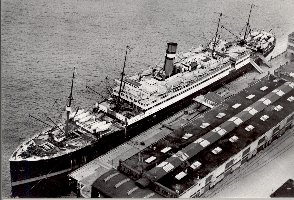
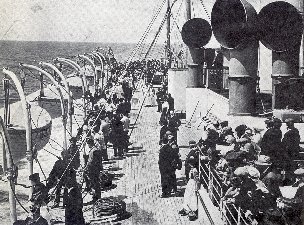
The Rijndam. Due to security precautions brought about by World War I, the ship was required to stop in England for three days with no one allowed to disembark the ship. Gertrude went on to write, "the ship and passengers were searched especially the German people and Russians." While each of the family members suffered from seasickness, Gertrude claimed to have enjoyed the trip. She later wrote, "They did everything imaginable on the ship, played cards, read books, there was a piano in the social hall where people played and sang. Many times we were unable to understand the music as different nationalities were on the boat." A reader could certainly sense the excitement and heightened optimism in Gertrude’s writings as she described her arrival in New York City. She wrote, "the night before we landed in New York harbor, everybody was so happy, they sang, danced, there was more noise that night than any other time during the trip. It was the most wonderful sight, to see all the lights of New York. Some of the passengers had relatives waiting for them in the grandstand. There was so much excitement everybody was waving their hat or handkerchief, they were pushing and crowding to be the first one to get off. The first thing we saw was the Statue of Liberty in New York harbor. It is the most wonderful statue I have ever seen." She explained immigration processing at Ellis Island and how designated individuals were responsible for answering immigrant questions in their native language. She described how her father asked about a place to eat and directions to the train station. The excitement of arriving in America was very quickly replaced with a very real sense of fear and anxiety. She wrote, "I never was so scared in all my life, I thought sure we would get lost, none of us could speak the American language. All we could say was ‘Sherburn, Minnesota’." After three days and two nights on the train, the Brolsma’s finally arrived at the depot in Sherburn. They were met at the station by Grandpa Jake, Herman, their Uncle Hessel and his wife, Agnes. The meat butchering business must have served Hessel well because Gertrude got to experience her first automobile ride after departing the station. She later explained that in Holland only doctors could afford motorized transportation and then, not every one of them. The family stayed with Hessel and Agnes that first year, and Gertrude actually then lived with them after the death of her sister and mother two years later. As Gertrude thought back on her first days in America she wrote, "I really had a different picture in my mind of America than it really was. But I can’t say that I ever was lonesome for Holland. One thing I noticed very much was the cold weather that winter." Grace and Gertrude’s introduction to American school life shortly after Christmas of 1916, was extremely difficult and quite traumatic. Gertrude wrote, "I really did feel lonesome at school, everybody watched us, we couldn’t talk or understand anything, all we could do was work arithmetic." Her statement provides a very good descriptor of the unfortunate position many immigrant children must have faced entering American schools. I once heard math called the universal language; Gertrude’s writings confirmed the notion that addition, subtraction, multiplication and division could be practiced in any language. She went on to state, "I was put way back in the third grade (she was in fifth grade in Holland), my sister was through the grades and was put back in the fifth. We were like first graders. This has been a disadvantage for me in my school life. We soon learned the American language so we could at least make people understand." Gertrude explained that during the first year their teachers would stay after school every other night and teach them how to read and write using the English language. She eventually graduated from Sherburn High School in 1927 at the age of twenty-one. Despite the loss of both her sister and mother just two years after arriving in Sherburn, the death of her uncle Hessel in 1922, and the frustrations of adjusting to American schools and other cultural differences, her spirits remained surprisingly upbeat. Like almost all immigrants of that day, nothing was going to dampen Gertrude’s spirit or erode her confidence that America was going to deliver on its promise of economic and social opportunities for everyone. In closing her life story, Gertrude offered up some of her optimism in describing her new home, but like the immigrant she was, it was naturally balanced with a conservative sense of realism as well. She wrote, "Sherburn is a fine little town, the people as a whole are of a good moral character. With the help of every citizen Sherburn is going to be successful in every way. The town is surrounded by beautiful lakes and also a fine cemetery in which I hope to rest some day." Gertrude did get her wish. Four years after graduating from Sherburn High School, she married Earl "Bud" Silverthorn in 1931. For seventeen years they enjoyed watching their three kids, Jim, Barbara Jean and Malcolm grow up in Fairmont; the county seat located approximately fifteen miles east of Sherburn. In 1948, after being hospitalized for five weeks, Gertrude died on the morning of May 19 in the Community Hospital. She was just forty-two years old, but had suffered with Hodgkin’s Disease for the good part of seven years. Four days later she was laid to rest in that fine cemetery in Sherburn; a poignant ending to a wonderful story about an extraordinary woman. The beginnings of a familyFollowing his jail time, Hessel Brolsma decided to try his luck in the United States. At the age of twenty-two he left St. Jacobi Parochie for America; determined to find his gold, a new career and, if he was really lucky, maybe even a bride. From all historical accounts, he was successful in each endeavor. Unfortunately, these historical accounts never described the reasons Hessel settled in Sherburn. One can only speculate that writings from friends who had immigrated earlier to locations around northwest Iowa, southern Minnesota and Wisconsin were a deciding factor. In the writings of her life story, Gertrude mentioned that Hessel had graduated from college at the age of nineteen, but disliked teaching to such an extent that while still living in Holland, he corresponded with a lawyer in Philadelphia to study law in America. She went on to write that Hessel, "came to America with his sister and husband and family. Due to the death of his sister’s husband he had to give up his plans, and help support her and her family which he felt was his moral duty." According to Jolke Brolsma’s research, two of his sisters, Attje Kooistra and Antje Faber immigrated with their husbands to Wisconsin in 1891 and 1894, respectively. Gertrude went on to write that her Uncle Hessel "was a lover of music, played the violin and piano. He also played the clarinet in the Sherburn band for many years. He was a great lover of mathematics which he told me was his favorite study. He was a friend of everybody, kind hearted and always jolly." Many of the town folk shared these same feelings towards Hessel, as his funeral would later demonstrate. Upon his arrival in Sherburn, he was employed by the manager of the local butcher shop, George Kidd. He continued his work as a meat cutter until 1919 when, according to the local paper, he purchased the business from Gettler and Benway. Within Gertrude’s papers was an undated picture of Hessel flanked by two of his employees. In the picture, the butcher shop floor that is not covered in saw dust contains a very distinctive pattern, the same pattern and flooring that exists today in Hagen’s TV shop on Sherburn’s main street. The top of the front facing of that building displays the name of the builder and its first owner, "Gettler". While Hessel’s obituary stated that he arrived in Sherburn in 1890, my research would indicate he actually entered the meat butchering business in Sherburn during 1892. The May 17, 1892 issue of the Sherburn Advance contained a rather odd note stating, "George Kidd tells us that while he may not run his butcher shop to suit the notions of all, he does his best he can under the circumstances, and if those who are disposed to find fault with his way of doing business would put themselves in his place for a few months they would discover that running a butcher shop is not so easy after all." Obviously, George had some issues, but I dare say I don’t think this would be championed as a great new advertising campaign in today’s market place. George must have later replaced his advertising agency because four months later in September, a regular block ad for the Sherburn Meat Market began appearing in each weekly edition. It read, "I desire to say that having secured the services of a first class butcher I am now better than ever before prepared to serve my patrons with all kinds of meat, fish and game in their season. Geo. Kidd. As they used to say in that business, "if you want to be in the meat business, you better have a first class butcher," and Hessel must have been the man. While it’s clear he didn’t care for customer complaints, give Mr. Kidd credit; he ran that same ad each week in the same paper well into the next year. On December 31, 1901, Hessel married Agnes Rosin of Kimball in Jackson County. While the couple had no children of their own, they raised Hessel’s niece, Gertrude, following the death of her mother in early 1919. In her writings, Gertrude used very kind words to describe her relationship with Aunt Agnes. She wrote that ever since the death of her mother "..I have been staying with my aunt. She is like a mother to me and has treated me as one. She has given me a fine home, has brought me up as a member of the Lutheran church." Later, and following the death of her husband, Agnes’s house was a home for other relatives from time to time. After Grandpa Jake moved his family to a farm north of Welcome in the late 1930’s, his second son, Leo, lived with his Aunt Agnes so that he could finish high school at Sherburn. During the turn of century, many Frisian immigrants wrote often to their friends and relatives still living in the homeland. Most times these letters wrote glowingly of the opportunities that continued to exist in America. While the descriptions of the economic opportunities were most likely true, many times these writings were veiled attempts aimed at convincing close acquaintances to join them in the United States in an effort to alleviate their own homesickness and loneliness. While none of his letters have survived, I’m quite sure Hessel was like other Frisians and his letters spoke many times of the grand opportunities in Minnesota. In fact, in 1910 he traveled to Holland to visit his family. The events that followed this trip would lead one to believe that Hessel returned to his homeland not only to visit, but also to convince his young nephews that America was the perfect place to begin their adult lives. Not long after he returned to Minnesota, Hessel found work for his oldest nephew with a local Sherburn farmer, and he sent for Grandpa Jake. A year later, another nephew, Herman joined them in Sherburn, and late in 1916, his brother Jacob and his family reached the United States for the first time. The December 21, 1916 issue of the Sherburn Advance Standard noted the arrival of the remaining Brolsma family members. It read, "Hessel Brolsma’s brother with his wife and two daughters arrived in Sherburn last week from Holland. Mr. Brolsma has come to America to make this country his home and in the spring will begin farming on a farm rented by his two sons, Jacob and Herman, who have been here for a number of years. Mr. Brolsma is already greatly in love with this country. He thinks it wonderful here." Jacob’s wife, Jitske, died on January 16, 1919, just one month after the death of their young daughter, Grace. The obituary in the local paper stated that while it appeared that Jitske had recovered from a bout of severe pneumonic influenza and a lifting of her spirits by a visit from her son, Herman, home on leave from Camp McArthur in Texas, a weakened heart caused her to suffer a relapse. Three years later, on October 25, 1922, Hessel died from complications of kidney and heart disease. The headline in the November 2, 1922 issue of the Sherburn Advance Standard read, "BROLSMA FUNERAL ONE OF THE LARGEST EVER HELD HERE – Attendance So Large Many Hundreds Unable to Gain Entrance to Church." Fifty-three years old, Hessel was described as one of the community’s best-liked citizens. The article went on to say, "While Mr. Brolsma’s death was not unexpected, the news of his passing came as a shock to everyone who knew him – for everyone who knew him was his friend. Hessel was known for his brusque but big-hearted, kindly and generous personality. He was one of those men who are ever ready and willing to sacrifice for his fellowmen. One of his characteristic greetings was a hearty, ‘Bon Jour,’ the French good day, which he acquired while in Holland, where the words are in common use. We are all going to miss this happy salutation now that this good man has passed on. As a citizen Hessel was embued (sp) with a fine sense of public spirit, always being ready to contribute as well as help in any movement to advance the interests of the community." Twelve years later on May 2, 1934, Hessel’s older brother and Grandpa Jake’s father, Jacob Brolsma, died at his home in Fox Lake Township. He was sixty-nine years old. At the time of his death, he was survived by just two of his ten siblings (his younger sisters, Attje Colby of Silver Lake, Wisconsin and Rinske Koch of Holland) and just three of his seven children (Jacob, Herman and Gertrude). On that unusually cold day in early May, the responsibility for building the Brolsma family in Martin county was handed to the next generation, a generation that already had lost more than half of its own members. History was later to demonstrate that Grandpa Jake took up this task with a great deal of earnestness and an immense sense of responsibility. Hidden on the inside pages of that same paper was an accounting of the agricultural production of Martin County farmers. According to the listing for Fox Lake Township, over ninety farmers tilled the township’s soil in 1934. Grandpa Jake farmed 210 acres, of which 145 were dedicated to the production of corn. During the previous year he had farrowed 23 litters and produced 132 hogs for market. After over twenty years of farming (the first several as a hired farmhand for Killian Weidenbach and John Manzey), he was the sixth largest producer of hogs and one of the larger farmers in the township; remarkable feats at that time when one considers he still as yet didn’t own any farmland and was just renting the Filberg farm across the lake from the Fox Lake Park. Almost nine years after arriving in Sherburn, Grandpa Jake married Luella Grupe on March 3, 1920 at St. John’s Lutheran Church in Dunnell, Minnesota. Of the wedding, the local paper wrote, "The bride looked pretty in a gown of white crepe de chene with silver trimmings. She wore a veil and a myrtle wreath and carried a shower bouquet of roses, sweet peas and carnations……The groom wore the conventional dark suit." Luella and Jake continued to farm in Fox Lake Township and were blessed with the births of four children (Florine, Lloyd, Leo and Wayne) during the first seven years of their marriage. In a very unfortunate turn of events, Luella died at her home on May 9, 1927. She had been ill since the birth of her son approximately seven weeks earlier and her death was attributed to peritonitis. The local paper wrote, "The untimely death of this young mother is a severe blow to the surviving husband and four young children, and they have the sincere sympathy of the community in this hour of deep sorrow." Luella was buried in the Sherburn cemetery on May 12, 1927, following a church service at St. John’s Lutheran Church officiated by the Reverend H.W. Neunaber. With the help of Luella’s sisters and Agnes Brolsma, Grandpa Jake tended to the farming and parenting responsibilities as best he could. A little less than three years later, on Thursday, January 9, 1930, Grandpa Jake married Henrietta (Hattie) Andriessen of Hawarden, Iowa. In an article published in the West Martin County News on the eve of Grandpa Jake’s ninetieth birthday in 1982, the couple told of meeting each other in a rather roundabout way. It seems that Hattie’s father and uncle knew Grandpa Jake’s father when they still lived in Holland. When a Dutch newspaper they received in Iowa mentioned the untimely death of Luella, they tracked down Jake and his family. When the reporter asked Hattie if it was love at first sight, Hattie responded in a fairly typical conservative Dutch fashion. "Oh, he was all right," she responded. When Jake was asked to comment on their long and successful union, he simply stated, "We lived happy all my life." I now possess the simple keys for assuring a successful marriage. I must tell my children to make sure your potential partner is "all right" and make sure you "live happy". That’s just like Grandpa Jake; always giving us simple instructions that are tougher than hell to execute. Over the first fifteen years of their marriage, Hattie and Jake shared in the birth of six children, culminating with the birth of twins in 1945 (Leroy, Robert, Raymond, Richard and the twins, Marilyn and Marlin). Despite farming for over fifty years, only six of Grandpa Jake’s children continued to farm after leaving home, and then only one, Robert, farmed his entire career. Bob and his wife, Norma, continue to live on the only farmstead that Grandpa ever owned, the Charles Hornberg farm located about a mile east of Sherburn. In a somewhat ironic twist of fate, this farm borders his younger brother Herman’s last farm. Despite immigrating to the United States out of personal frustration with the inability of anyone to acquire land in Friesland, Grandpa Jake continued to rent farm ground for over thirty years until 1944, when he purchased his first and last farm near Sherburn. In that same newspaper article noting Grandpa Jake’s upcoming ninetieth birthday, he described for the reporter how he felt about owning his own farm place after years of working for others or renting. Not really long on words, Grandpa simply said, "I got it made." Yes, Grandpa Jake did have it made. But his possessions and accomplishments were only the result of hard work, dogged determination (some might say Dutch stubbornness) and a consistent sense about doing things right. In many respects, his children and grandchildren have it made as well. All we need to do is follow closely in the footsteps of our champion and try our hardest to emulate his approach to life, work and love. Oh, and it probably wouldn’t hurt to "live happy". Grandpa Jake passed away on September 4, 1986, twenty-three days shy of his ninety-fourth birthday. He and Hattie, who died less than three years later in April of 1989, are buried in that fine cemetery in Sherburn. Some final thoughtsMy task is complete. I must be honest though and confess that I did not accomplish my original objective. A lack of specific historical accounts of my Grandpa’s life was a significant factor in my failure to find satisfactory answers to the questions I enumerated in the beginning. To my chagrin, there exists no national museum or local library to house the personal diaries and accounts of common folk. Like it will be for most of us, historical information on our life’s experiences will most likely only be etched in the memories of those individuals whose lives we have touched on a regular basis. If we are fortunate, someone like Gertrude will be sufficiently gracious to document the notable incidents. Hopefully, these writings will not be limited to historical accounts, but will also document personal thoughts on the events and issues of the day, their plans, their frustrations and anxieties, and those episodes that always seem to bring a small smile to our face when thoughts turn to remembering the past. If we’re really lucky, maybe, just maybe, the writings will include a sentence or two about each of us. Of course, we really don’t have to leave it all to luck. History really doesn’t have to repeat itself. This recent exercise confirmed for me that telling stories and writing personal accounts is really not a lost art. It’s just something that needs to be practiced on a more regular basis. Think about the last time you gathered with long-time friends over beers or coffee to relish past memories and simply ignore the day’s pressing issues. Think about the joy it brought you; the laughter, the sadness and yes, maybe even a little reflection on how events could have played out just a little bit differently had your actions or words been changed. Coming up behind you are many people whose lives you have and will continue to touch. Give them a little bit of history; provide them with every opportunity to know you better, to understand your values and to learn from your finest missteps and misdeeds. These people surround you every day and they are waiting patiently. Just as reading Tom Brokaw’s book, The Greatest Generation, finally turned the light bulb on with respect to understanding my parent’s system of values and beliefs, this little exercise awakened me to the joys, tribulations and heartaches of immigrants new to this country. In an era where rather routine issues can set off anxiety attacks and find us scrambling for the phone number of our personal counselor, I found myself profoundly impressed by the sense of optimism displayed by Grandpa Jake and his ilk. Possessing an unbelievable confidence in America’s ability to deliver on its promise of economic and social opportunity, these people stared down death, poor crops, world wars and frequent monetary setbacks to become the leaders of our communities, our churches, and most importantly, our families. For this we all should always be grateful. Early on, I made light of Grandpa’s size. After all, he was not blessed with great height. But for those of us fortunate to know him, we all recognized that while Grandpa Jake may have been short in height, he was a man very long in stature. He was our family’s leader, our biggest fan and our disciplinarian. He was a man who was keenly aware of his role and responsibilities as the family patriarch and he played the role perfectly. From the days of struggling to order a cup of coffee and a piece of pie, he grew to head a family with members living from coast to coast; from Texas to the upper reaches of northern Minnesota. The numbers speak for themselves. After raising two daughters and eight sons, his descendents now number thirty-one grandchildren, fifty-four great-grandchildren and even a couple of great, great-grandchildren. Of course, times have changed. It’s no longer just coffee and pie. Today, his descendents hop into their SUV’s and head for the nearest Starbucks. They also have no problems ordering a tall double skinny latte, extra hot with sugar free vanilla and a maple scone. This morning as I dropped my designer coffee mug into the beverage holder and strapped the seat belt around my richly rewarded stomach, I had this image of Jake smiling down and reminding me "Hey Brad, America sure is a great country isn’t it?" You betcha, Grandpa! Brad Brolsma |